

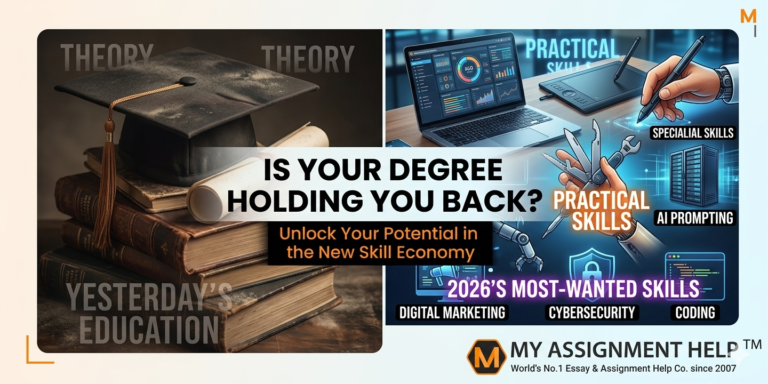
The traditional career roadmap—graduate high school, earn a four-year degree, and climb the corporate ladder—is undergoing a seismic shift. As we navigate 2026, the global economy is no longer just “disrupted” by technology; it has been entirely rebuilt around it. For many professionals, the expensive parchment hanging on their wall is starting to feel like a relic of a slower era.
The question isn’t whether education matters—it does—but whether the format of that education matches the speed of the modern market. In a world where AI capabilities double every few months, a curriculum designed in 2022 often fails to meet the demands of a 2026 workspace.
The 2026 Reality: Degrees vs. Deliverables
In 2026, the “degree inflation” bubble has finally burst. According to recent labor statistics, nearly 65% of Fortune 500 companies have officially removed four-year degree requirements from their entry-level and mid-management job postings, opting instead for skill-based assessments. Employers are tired of onboarding graduates who understand the theory of “Market Dynamics” but cannot navigate a real-time data analytics dashboard.
This shift is particularly evident in technical and creative fields. If you are struggling to keep up with the workload of transitioning from academic theory to professional application, you might find yourself looking for experts to complete my assignment or projects that bridge that gap. The market now values “deliverables” over “diplomas.” If you can code a functional app, manage a cross-border remote team, or execute a high-conversion SEO strategy, your GPA becomes a secondary footnote.
Why the “Skills First” Model Won?
Several factors have contributed to the dominance of practical skills over traditional degrees in the current landscape:
1. The Half-Life of Knowledge
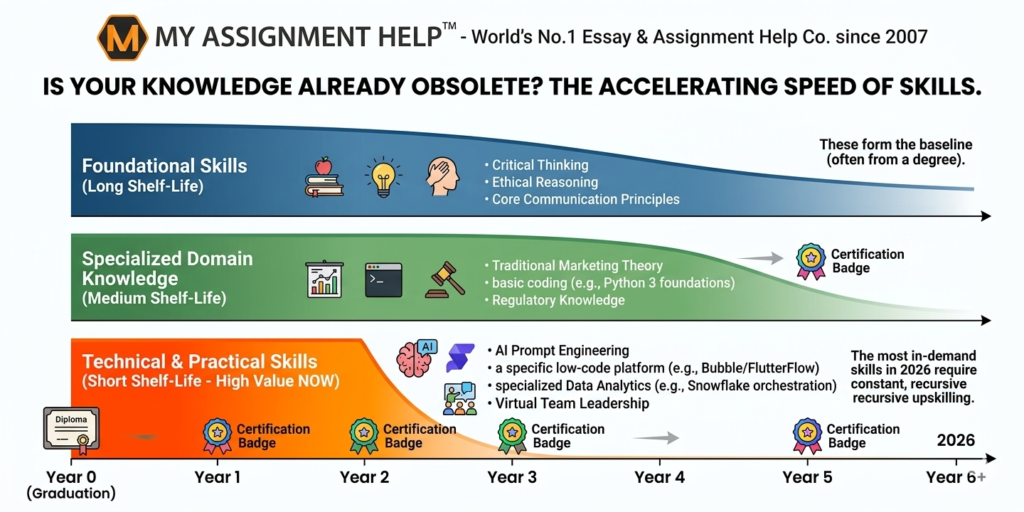
In the 1980s, the “half-life” of a learned skill was roughly 30 years. Today, it is estimated to be less than five. By the time a student enters their senior year, the software or methodologies they learned as freshmen are often obsolete. Practical skills, gained through certifications, bootcamps, and hands-on projects, allow for “just-in-time” learning that keeps pace with industry changes.
2. The Rise of the “Portfolio Career”
Hiring managers in 2026 prioritize portfolios. Whether it’s a GitHub repository, a Figma showcase, or a documented history of successful marketing campaigns, tangible proof of work is the new resume. Many students find that the pressure to maintain high grades often pulls them away from the very projects that would actually get them hired. In these instances, choosing to pay someone to do my homework becomes a strategic move to free up time for high-impact certifications and real-world internships.
3. Economic ROI
With the cost of higher education in the US reaching record highs, Gen Z and Alpha professionals are performing ruthless ROI calculations. Why spend $150,000 on a degree when a $2,000 specialized certification in AI Prompt Engineering or Sustainability Consulting leads to a $90,000 starting salary?
See also: SEO Tips for Small Business Owners: Boost Your Online Presence and Drive Traffic
The Skills That Actually Matter in 2026
While technical skills vary by industry, a core set of “Human-Centric Practical Skills” has become the universal currency of the 2026 workforce:
- AI Orchestration: It’s no longer about knowing how to use AI, but how to integrate multiple AI agents into a seamless workflow.
- Data Literacy: The ability to interpret data and turn it into a narrative. Machines can calculate; humans must decide.
- Adaptability Quotient (AQ): While IQ and EQ remain important, AQ—the ability to pivot in response to rapid technological shifts—is the top trait sought by recruiters this year.
- Cross-Functional Communication: As remote work evolves into “metawork” (collaborating in virtual environments), the ability to communicate complex ideas across different time zones and cultures is vital.
Is the Degree Totally Dead?
Not exactly. The degree still serves as a signal of discipline and foundational knowledge in regulated fields like medicine, law, and structural engineering. However, for the vast majority of the “Knowledge Economy,” the degree is now the foundation, while practical skills are the skyscraper.
The most successful professionals in 2026 are “T-Shaped”—they have a broad base of general knowledge (often from a degree) but deep, specialized expertise in a practical, high-demand skill.
Key Takeaways
- Skills > Pedigree: 65% of top employers now prioritize skill-based hiring over degree requirements.
- The 5-Year Rule: Most technical skills now have a half-life of five years or less; continuous upskilling is mandatory.
- Portfolio is King: A documented portfolio of work is more influential than a high GPA in creative and tech sectors.
- Strategic Outsourcing: High-performers often outsource routine academic or administrative tasks to focus on building high-value, practical expertise.
FAQ Section
Q: Should I quit my degree to focus on skills?
A: Not necessarily. If you are close to finishing, the credential still holds value as a “baseline.” However, you should supplement your studies with practical projects and certifications simultaneously.
Q: What are the best ways to gain practical skills in 2026?
A: Look for industry-recognized micro-credentials from platforms like Coursera, LinkedIn Learning, or specialized bootcamps that offer “hands-on” labs rather than just video lectures.
Q: How do I show “practical skills” on a resume?
A: Use a “Project-Based” resume format. Instead of just listing your education, create a section for “Key Projects” where you detail the problem, the tool used, and the measurable result you achieved.
Q: Does the “Skills First” trend apply to international jobs?
A: Yes, particularly in US, UK, and Australian markets where the digital economy is most advanced. Remote work has made skills the primary language of global hiring.
Author Bio
David Miller is a Senior Content Strategist at MyAssignmentHelp. With over a decade of experience in the EdTech sector, David specializes in analyzing labor market trends and helping students transition from academic environments to high-growth professional careers. He is a staunch advocate for skill-based education and lifelong learning.
References:
- U.S. Bureau of Labor Statistics (2025-2026 Outlook): The Evolution of Degree Requirements.
- World Economic Forum: The Future of Jobs Report 2026.
- Harvard Business Review: The Micro-Credential Revolution and the End of the Traditional Resume.