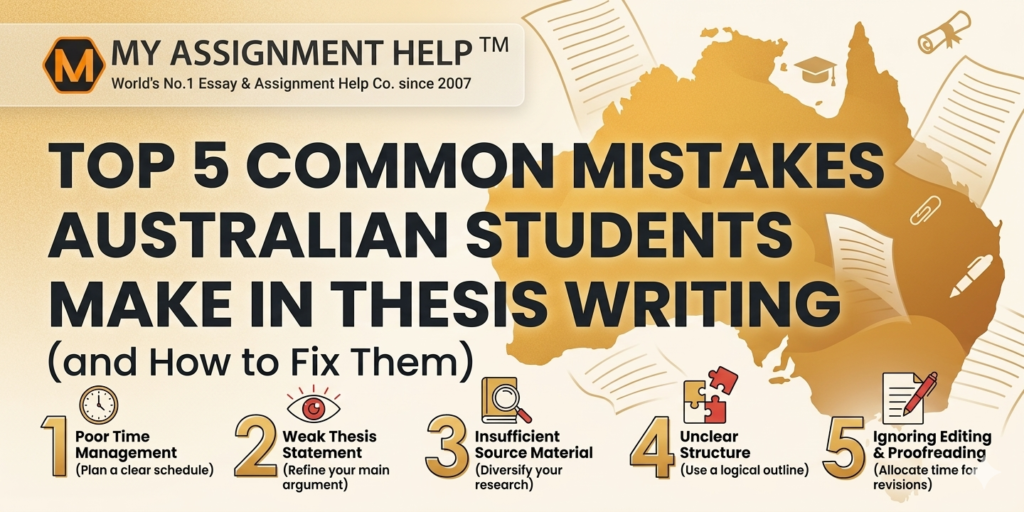
Embarking on a thesis is the pinnacle of the Australian higher education journey. Whether you are at the University of Melbourne, ANU, or USYD, the pressure to contribute original research to your field is immense. However, according to recent academic integrity trends and 2026 university benchmarks, many postgraduate students stumble not because of a lack of knowledge, but due to avoidable structural and strategic errors.
The Australian higher education sector, regulated by TEQSA (Tertiary Education Quality and Standards Agency), has seen a sharpened focus on “Research Quality” and “Academic Integrity” in 2026. With Australian universities now ranking in the global top 50 for subjects like Law, Engineering, and Education, the bar for your dissertation has never been higher. To secure that High Distinction (HD), you must navigate the common pitfalls that lead to “minor revisions” or, worse, a “fail” grade.
If you find yourself overwhelmed by these complexities, seeking professional assignment writing help can provide the structural guidance and clarity needed to align your research with Australian AQF Level 9 and 10 standards. This support ensures your academic voice remains authentic while adhering to the rigorous technical requirements of your specific faculty.
1. The “Kitchen Sink” Problem: Lack of a Clear Research Focus
One of the most frequent mistakes is choosing a topic that is far too broad. Many Aussie students fear that a narrow topic won’t provide enough data. In reality, a “broad” thesis leads to superficial analysis.
- The Mistake: Trying to cover “The Impact of Climate Change on Australian Agriculture” in 15,000 words.
- The Fix: Narrow your scope using the PICO (Population, Intervention, Comparison, Outcome) framework. Focus on a specific region or crop, such as “The Economic Impact of Drought-Resistant Wheat Strains on Farmers in the Wimmera Region (2020-2025).”
2. Descriptive vs. Critical Literature Reviews
In the 2026 academic landscape, examiners are no longer looking for a “summary” of what others have said. They want to see a thematic synthesis.
- The Mistake: Writing a literature review that reads like a list (e.g., “Smith (2023) said X, then Jones (2024) said Y”).
- The Fix: Group your literature by themes or “debates.” Identify the research gaps. Your job is to show why your thesis needs to exist because previous research missed a specific angle. For students in vocational or professional streams, looking at specific case studies like chcprp003 assessment answers can illustrate how to reflect on industry-standard practices and integrate them into critical academic discussion.
See also: How to Set Up Google Analytics 4 Step by Step
3. Misalignment of Methodology and Research Questions
Your methodology isn’t just a list of tools; it’s the logical bridge between your question and your answer.
- The Mistake: Choosing a “Qualitative” approach simply because you dislike statistics, even if your research question demands quantitative proof.
- The Fix: Ensure “Methodological Congruence.” If your question asks “How much,” you need quantitative data. If it asks “Why” or “How,” qualitative interviews are your best bet. Always justify your choice by citing standard methodology texts (e.g., Creswell or Denzin).
4. Ignoring the “Australian Context” in Global Research
Australian universities pride themselves on local relevance.
- The Mistake: Using purely North American or European frameworks without acknowledging Australian-specific variables like the Fair Work Act, indigenous perspectives, or unique regional geography.
- The Fix: Localise your research. Ensure your bibliography includes Australian scholars and government reports (like ABS or AIFS data) to show you understand the domestic landscape.
5. The “Last-Minute” Referencing Nightmare
With the rise of sophisticated plagiarism detection software in 2026, even “unintentional” plagiarism can lead to severe penalties from university boards.
- The Mistake: Leaving the bibliography until the week before submission.
- The Fix: Use referencing software (EndNote or Zotero) from Day 1. Ensure you are using the correct version of the style required—whether it’s APA 7th, AGLC4 (for Law), or Harvard (UTS/Monash style).
Key Takeaways for Success
- Specificity is King: A narrow, deep thesis beats a wide, shallow one every time.
- Be Critical: Don’t just report; evaluate the evidence.
- Ethics First: In Australia, ethical clearance is non-negotiable for human research.
- Seek Feedback Early: Don’t wait for your supervisor to find errors in the final draft.
FAQ: Thesis Writing in Australia
Q: How many words should an Australian Masters thesis be?
A: Typically, a Masters by Research thesis is between 12,000 and 50,000 words, depending on the credit point value and the specific university guidelines.
Q: Can I use AI tools like ChatGPT for my thesis?
A: Most Australian universities allow AI for brainstorming or editing, but using it to generate substantive content is considered academic misconduct unless explicitly stated in your unit guide.
Q: What happens if I fail my first thesis submission?
A: Usually, you are given a “Revise and Resubmit” (R&R) status. You will have a specific window (3-6 months) to address the examiners’ concerns.
References
- Australian Bureau of Statistics (2025). Education and Work, Australia. ABS Website.
- Tertiary Education Quality and Standards Agency (2024). Guidance Note: Research and Research Training. Australian Government.
- Universities Australia (2025). Academic Integrity Best Practice Principles.
- University of Queensland (2024). Thesis Writing Tips and HDR Candidature Support.
Author Bio
Dr. Sarah Mitchell is a Senior Academic Consultant at MyAssignmentHelp. With over 12 years of experience in the Australian higher education sector, she specializes in guiding postgraduate students through the rigors of dissertation writing and research methodology. Sarah has helped thousands of students at RMIT, Curtin, and QUT achieve academic excellence by simplifying complex research frameworks.